{Scientists still don’t know why the cicadas emerge every 17 years.}
That’s not an exact quote from ABC News reporter Claire Shipman, but it is fairly close. On this morning’s GMA, she filed a report about the emergence of “Brood XIII,” a noisy event to be sure. For a moment, I was baffled as to why she’d refer to the 17-year cycle as a mystery, especially since the answer is based in math and common sense. (And was the subject of several articles by the late Stephen Jay Gould as far back as 30 years ago.)
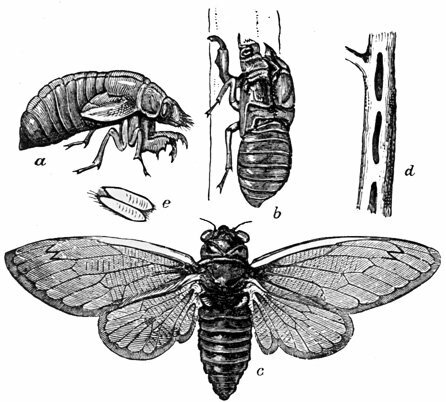 It’s simply a matter of evolution and adaptation. It’s a survival strategy. Burst forth in giant numbers, and predators will never be able to eat your species to extinction. However, if you emerge from your slumber every year, your predators can adapt their numbers to enjoy a regular lunch. If you pop up every other year, you’ll be a meal for every predator with an even-year cycle of its own.
Over the generations, those cicadas that emerged on a cycle that was a prime number were the least likely to bump across a predator with cycle that might sync up (and wipe out the brood.) Which explains why the two largest brood cycles are now 17 years and 13 years – two somewhat large primes that don’t fit any easy multiples.
What I find interesting would be the eventual intersection of those two brood cycles, which happens every 221 years. There’s no real guarantee that both would pop up within the same window, but it is possible (broods make their noise, make their babies, and die off within 30 days or so.) The 13-year Brood hit in 2004, with the 17-year Brood firing up now. Here is the breakdown of future years:
|
13-year Brood |
17-year Brood |
|
2004 |
|
|
2017 |
2024 |
|
2030 |
2041 |
|
2043 |
|
|
2056 |
2058 |
|
2069 |
2075 |
|
2082 |
2092 |
|
2095 |
|
|
2108 |
2109 |
|
2121 |
2126 |
|
2134 |
2143 |
|
2147 |
|
|
2160 |
2160 |
Looks like we’ll have to wait until 2160 to see what a double-shot of cicada swarms looks like.
As to the real ‘mystery’: why was the explanation of the cycles left out of the television version of the report?
Some scientists are not yet convinced this is the case, even if it makes every bit of sense and explains a bona fide observation with minimum outside factors. (A clear example of the application of Occam’s Razor.) However, for the purposes of morning television, it takes too long to explain the math. A 45-second interlude on the nature of prime numbers and the survival strategy of bugs would be quite costly to the network, which needed that time to better educate the audience about the latest in the O’Donnell-Hasselback feud from the view.
[tags]Ike Pigott, Occam’s RazR, Stephen Jay Gould, evolution, prime numbers, Occam’s Razor, science, math[/tags]
