{{myquote|When it comes to trading Freedom for Security, we’re like the poor fools who only go to the grocery store when we’re starving; then wonder why we’re poor, fat, and have a pantry loaded with fluff.}}

communication. community. cognition.
{{myquote|When it comes to trading Freedom for Security, we’re like the poor fools who only go to the grocery store when we’re starving; then wonder why we’re poor, fat, and have a pantry loaded with fluff.}}
 Another day, another dollar. A day late, a dollar short. Dollars to doughnuts.
A dollar is a unit in flux, but it’s a unit that represents our time, effort, and attention.
How much would you pay for a new car? WAIT! Before you answer, how would you rather pay for a new car?
Those were chosen completely at random, and on purpose. There is no attempt at equivalence here, there may be one of the above that is much easier for you to attain. And that’s the way it’s supposed to work. Fortunately, we live in a society where there is a common medium of currency, which makes the comparisons easier. Much easier than when we had to barter for goods.
Life in a “five cows for an acre” society is not nearly as efficient. When there is a common ground, a coin of the realm, trade gets streamlined. You don’t waste valuable time (another commodity) choosing how to pay or what means of compensation you’ll accept. You do business, and you move on. In societies that lack stable currency, you’ll see underground markets emerge swiftly to fill the need. Prisons are full of people who’ve learned how to barter. So are nations with economic and military strife. Many look down on such situations as being uncivilized, but they may put their participants even closer to civility than we realize.
Dollars are abstract things, but when we become so familiar with them they take on very non-abstract qualities.
Most importantly, dollars can become so central to our thoughts and conversations that they get in the way of how we might compare other abstract notions — and once we have a strong vested interest in considering.
Money isn’t everything, and is not the measure of everything. Take Freedom and Security, for example. In an ideal world, we max out on both. But we don’t live in an ideal world, and that’s why we sometimes have to trade in one to “purchase” the other. Don’t want people to threaten or harm you? Then enact and enforce laws that infringe on the freedom of others to harm. Want to feel the freedom of riding without a helmet or a seatbelt. Enjoy it, knowing you have diminished your security by a very vague but very real amount.
Why did I start talking about dollars? Because in a world where there is always a medium of exchange, we don’t do a very good job calculating the exchange at face value. How much is Freedom worth? How much is Security worth? And how do we strike the best balance?
It’s easy to say that we ought “shop” for Security the same way we shop for Shoes. Look for a good fit, and shop around for the best value. After all, you’re going to do a lot of walking in them. Yet how often have we bought into a line of rhetoric or argument that overemphasizes one part of the balance? And how often do we ignore real tangible threats in proportion to bizarre and rare ones that enjoy news coverage?
Many of the contentious political issues of the day fall under the Freedom vs. Security paradigm.
Without really verbalizing it, most of the people who argue passionately are effectively saying the same thing: (issue) is/isn’t a good deal. We’re giving away too much A to get too little B.
What do smart shoppers do? And can we apply those lessons to issues of liberty and survival? Of course we can – we just have to tap into that part of the brain that recognizes a barter situation, and can haggle for the best exchange.
Smart shoppers:
Have we traditionally gone about purchasing security? We wait until there is a terror attack or a financial panic, and we give away everything for a tiny morsel of safety.
And how have we traditionally gone about purchasing freedom? Some actually serve in the military, but for the most part we inherited it. Americans enjoy a windfall of freedom that we haven’t done squat to earn, so there is no real cost attached to it. The only parallel might be those fighting for financial freedom, but there again we’re back to dealing with Dollars again. Back to the tangible.
Is it any wonder we’ve done such a horrible job managing our Freedom and Security? We have an asset (Freedom) that we spend like Other People’s Money that will never run out, and we spend it on the most extravagant reassurances at the worst time and at the highest cost. We’re like the poor fools who only go to the grocery store when we’re starving; then wonder why we’re poor, fat, and have a pantry loaded with fluff.
Now consider: Everything that happens in government at any level is happening because of your effort. Your tax money made it possible for representatives and bureaucrats to make decisions about how you are exchanging your Freedom and Security – and often not to your benefit either way. Your gave up your freedom to engage in activities that allowed you to trade time for money. And the government took a portion of that money. Think about this next time you hear anything about Homeland Security, or a Bailout, a Tax Proposal, or any bill: Am I salivating at the deal? Or am I just so starved that I’ll swallow anything, no matter how harmful?
[tags]Ike Pigott, Occam’s RazR, Freedom , Security, Homeland Security, terrorism, government, economics[/tags]
Too often we use needless complexity to obscure the truth from ourselves. Sometimes, it’s because we need to be numb to the truth.
An example of this at the personal level is those who don’t balance their checkbooks because they know they won’t like the result. Ignorance is bliss. But at least we can point the finger of blame at the guy in the mirror. Not so when the books are scrambled to disguise reality.
What is your answer to these two questions?
If you’re normal, you probably answered the first question in terms of your base salary, and your second in take-home dollars. There’s a disconnect. You ought to be able to divide X by either 24, 26, or 12 and come up with Y. But you don’t, because you’ve been conditioned by payroll deduction and withholding taxes to never consider that money “yours” to begin with.
This is what we call a “cognitive dissonance.” One part of your brain acknowledges a fact while the other denies the logic conclusion that results. I “know” that’s my money, but since I never get to spend it or see it, it isn’t really.
When Congressmen run for re-election, they like to tout all the Federal dollars they brought home for local improvements. Everyone likes smooth roads, and new parks, and museums, and money to expand the community centers where the senior citizens go to dance. That’s admirable, but it’s deceptive. It was our money, we just never thought about it that way because we used convenient accounting to block it from our memory.
The net result is we feel happy because projects get built and we didn’t have to pay for them. Since no one is apparently attached to those individual dollars as producers, we don’t have the traction to claim ownership. Yet every one of those dollars came from someone who may have had a nobler purpose for them.
It’s so easy to spend Other Peoples’ Money, because there is a seemingly limitless supply of it. The hidden evil is that you never really spend Other Peoples’ Money as responsibly as you do your own.
There’s on other area we obscure the truth on our paystubs. It’s on that line for health insurance. For those that have some sort of employer-negotiated plan, there’s a significant expense that goes into adding that benefit. Again, we never see it. We just blindly assume that it’s the best deal we could get, and don’t consider what we might have done with the same money in our pockets. Also, we ignore that money when calculating what a new hire will cost the company (unless you’re in management, and actually do the budgets, but even some of those are obscured or added in later en masse by accounting.)
If you think all of the above make taxation and government more convenient, you’re absolutely right. If you think they are worthy ideas and make for acceptable accounting, then please do the following:
The next time you go to a restaurant, tell the server up front to decide what percentage your tip ought to be. Tell him to add that tip onto your credit card receipt, but only give you a slip showing the pre-tip amount. Then order a dessert from a very limited menu with that has no prices listed. Pick the one that sounds the best, tell the server to only put the part to the right of the decimal to your visible tab, and never consider for a moment that you’d have been just as happy with an ice cream cone outside for a fraction of the cost.
Sometimes, the best transparency we can provide is to remove the blinders from our own eyes.
This is as good a time as any to share this story.
The year was 1996. A fresh face in Birmingham television, I was part of a startup newsroom that was trying to make a name and a reputation in a competitive but conservative market. Viewers just didn’t wander, they had habits. They also had established stations they had watched for decades. So it was incumbent to come in and act as though we’d been there all along. “We want to compete from Day 1,” said my news director.
There were more than a few opportunities for us to flex our muscles as a news organization. We signed on September 1 of that year, in time to catch the end of a busy election season. We had some severe weather to display our worth. But no event loomed on the horizon like the Iron Bowl, with rumors swirling that Alabama coach Gene Stallings was going to retire soon.
 For those of you from outside the state, the annual Alabama-Auburn game is one of the most intense and absorbing rivalries in all of sports. Fans from other schools brag to me about how their trash talk starts before the season. In the Iron Bowl (so named because it used to be played in Birmingham,) the trash talk for next year’s game starts midway through the second quarter of this year’s game. Life stops for one day a year, and legions of fans have a personal stake in happiness for the next 364 riding on 60 minutes of smashmouth football.
As a station, we had to get it right.
Coverage of the Iron Bowl starts weeks before, but in the seven days prior you’re looking at some heavy presence in the newscasts throughout. Feature angles abound. And that’s where we get to the legendary coach, Paul Bryant.
My photographer that day was Chris Osborne, and while working on an actual story of substance, we were asked to take a little bit of time to swing by Elmwood Cemetary. Our News Operations Director had a special video request for us.
(paraphrased) “Go by Coach Bryant’s gravesite at Elmwood Cemetary and get some video.”
What for? What of? Why?
“Every year, fans go by the site and leave bottles and cans of Coca-Cola, and Golden Flake potato chips.”
I won’t fake the rest of this conversation, but it went on for minutes.
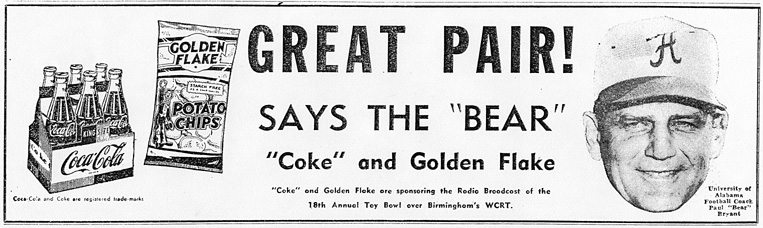
For years, Bryant was a pitchman for the snacks, even eating them while narrating the highlights of the coach’s show. And apparently, some people do indeed bring the items to the gravesite, but we didn’t know enough about the tradition to point out that it’s generally done on the date of his death, and not as part of Iron Bowl week.
 Here’s the proof. The Birmingham News did a nice writeup back in January on the 25th anniversary of his death. But that was of no help to us then, as neither of us were steeped enough in the lore of Birmingham to have known. (I was a Bama grad, and didn’t know!)
Because of our sheer confusion that such a thing could occur, the assignment desk starting treating us as though we were being “problem children.” Nothing could be further from the truth. We wanted to get our little piece of video and get on with the story. The only problem was none of the desk people could tell us how to get to the gravesite, and Elmwood is huge. “Follow the crowds,” they told us. “There are no crowds,” we said.
After more than an hour of following the winding pathways of Elmwood (which was pretty much empty,) we finally arrived at our destination…
…and there was nothing there. Nothing to see.
I called in and spoke to my managers, who were so convinced that we were trying to kill the story, they didn’t believe that there was nothing there.
“Surely there is something there.”
“Nope. Not a thing.”
“I know it might not look like much, but shoot it anyway.”
“There’s nothing to shoot. Nothing. But tell you what – I will bring whatever I find on Coach Bryant’s grave back to you in the newsroom.”
And with that, I picked up a pair of walnuts, the only objects on the gravesite other than dead grass and the occasional blowing leaf.
When I returned, I marched up to the managing editor and dropped the walnuts in his hand.
“What are these,” he asked.
I told you we’d be bringing back whatever we found on the grave. Those are Bear Bryant’s nuts.
[tags]Ike Pigott, Occam’s RazR, Alabama, Auburn, Iron Bowl, football, Paul Bryant, Golden Flake, Coca-Cola[/tags]
(Another Modest Proposal for your consideration)
Tax cut. Tax hike. Tax break. Tax loophole.
 The sad piece of it is that those of us who do pay income taxes have become numb to the baseline. The money is ours to begin with, and then the government confiscates it (under threat of imprisonment) for some nobler public purpose. Some might have you think it’s the other way around.
Which brings us to the people for which there is no income tax. There are two types: those that earn on capital gains (and are taxed appropriately), and those who don’t earn enough income.
The first we won’t really bother with at the moment. They’re not listening anyway, as they are trying to lock up their assets or move them overseas as we speak.
The second group – those with low incomes – have through no fault of their own become divorced from the real relationship they ought to enjoy with their proceeds and their government. When Uncle Sam only gives you things and never asks for anything in return, then you tend to see him as Santa Claus. (Both wear ridiculous suits, and enough trips to the pork-barrel will equip Sam with the requisite figure for Nick.)
My plan is to reconcile the poor with their patriotic duty to pay taxes.
Here’s how the All-tax works. Every household making less than $45,000 in a year will receive a $5,000 check from the Federal Government. However, by accepting the check they immediately enter into a minimum 10% tax bracket.
Yep. Ten percent. And the check from the government is taxable.
If you make $45,000 your five-grand All-tax bonus would take you up to $50,000 – and the 10% tax sets you right back where you were. If you make less than $45,000 you end up to the good, and of course those making more than $45,000 are unaffected. This has the net effect of making every American household a tax-paying household without increasing the burden on anyone.
When everyone has the same conscious recognition of the role they play in supporting the government, it changes perspectives quickly.
Your thoughts? What am I missing? Am I evil?
The is the first part of my Modest Proposals for Change. Change I can believe in.
Get Congress out of Washington.

Greater Washington is one of the most segregated, dysfunctional cities on the planet. Having our elected representatives spend the majority of their time in a toxic place cannot be good for their outlook. Even worse are those that cocoon themselves within the padded and happy bubble of private schools and swank surroundings. They go, they plug in, and they lose touch.
So let’s get them out of there.
If telecommuting is the wave of the future, let’s get our Federal government in front of that movement.
Let’s get them back to their home districts. Let them do video conferencing with their committees. Let them vote remotely, and have every vote electronically tabulated (no more voice-vote games). Let them eat breakfast with their constituents. Let them be more open and transparent, with more meetings available for people to peruse online.
Most importantly, let’s get them out of a cluster that is convenient for lobbyists. K-Street can only exist if there is in fact a street close enough to lobby all of them on the cheap. No lobbyists, no revolving doors, no secret huddles. Let them lobby in person by flying around the country, where they can be tracked. Let them lobby over the phone, where there are records that can be subpoenaed, and make those phone records public and searchable too.
We the People don’t trust our Congressmen as far as we can throw them. So let’s keep them close enough that we can throw them. Maybe, just maybe, we’ll get a better degree of representation. It would certainly cost less than what we have now.
 I saw a “lower-third” graphic on CNN yesterday afternoon that stuck in my craw:
Dow up 151 points,
Housing prices down 9%.
Now, I’m not going to complain about the fact the two are completely unrelated. And given the economic uncertainty, I wouldn’t even mention a correlation. But just what are we supposed to glean from that juxtaposition?
The Dow Industrials moved 150 points in a day. In a quick glance, are we to assume housing prices dropped nearly 10 percent in one day?
Daily movements in the Dow have very little meaning. In fact, the talking head econ-pundits rarely give anything but speculation about why stocks did this or that. Sure, a specific company might issue news which causes a sharp move, but daily variations seldom matter. It’s long-term trends that real investors need.
Same with real estate. Housing prices are down 9%, but over what period of time. And how far do you go back for it to show a rise? It’s an empty statistic, devoid of even the most basic information to provide context.
The only thing I can guarantee in these uncertain times is that television news will do its level best to shrink meaningful time further. Every moment is a crisis-in-the-making. Every decision is make-or-break. And every moment you’re unplugged from the random barrage of contextually-empty data on the news, you’re in danger of losing your mind and your fortune.
(and the sales departments at the cable nets are in danger of losing their remaining advertisers.)
[tags]Ike Pigott, Occam’s RazR, journalism, cable news, economics[/tags]

